





TABLE OF CONTENTS
- First Job and the Right to Vacation. What Do the Laws Say?
- How many days of vacation are you entitled to for each month of your first job?
- When can you take your first vacation? Specific examples
- 20 or 26 days of vacation? Length of service matters
- Changes to Length of Service in 2026. Who Can Get More Vacation Time?
- Your First Job and Changing Employers: Don't Confuse These Rules
- Can I take vacation time before completing my first month of work?
- Is unused vacation time from the first year forfeited?
- Your First Year on the Job and Vacation Time: What Should You Keep in Mind?
Are you starting your first job and planning a vacation? Don’t assume you’ll have 20 days of vacation time right away. Different rules apply during your first year of employment than for employees with prior work experience. You earn vacation time gradually, and the amount depends on the time you’ve worked and your vacation seniority. Find out how many days of vacation you’re entitled to, when you can take your first vacation, and how to correctly calculate your vacation entitlement in 2026.
01
First Job and the Right to Vacation. What Do the Laws Say?
The basic rules for granting vacation leave are set forth in the Labor Code. According to Article 153, a person starting work for the first time acquires the right to vacation leave gradually, at the end of each month of employment. This means that signing the first employment contract does not automatically entitle the employee to use the entire annual allocation of vacation days. You must first earn the right to vacation, as the number of days increases with each passing month of employment.
Importantly, this rule applies only to the calendar year in which an employee first begins employment under an employment contract. It does not matter whether the employee starts work in January, June, or November. In each of these cases, the right to vacation accrues after each month of work, and unused vacation days accumulate. These rules apply to adult employees. For minors, the Labor Code provides separate regulations.
The situation changes at the start of the next calendar year. The employee then acquires the right to the next vacation under the general rules, without having to wait for the end of each month. If an employee remains employed on January 1, they generally acquire the right to the annual leave due for that year as of that date. This is a significant difference, especially for those starting their professional careers toward the end of the year.
02
How many days of vacation are you entitled to for each month of your first job?
An employee whose annual leave entitlement is 20 days acquires the right to 1/12 of that amount after each month of initial employment. This amounts to exactly 1 and 2/3 days of leave per month of employment, or approximately 1.67 days. The entitlement arises only after the end of a given month of work, not on the first day of employment.
Accuracy is essential when calculating the first vacation entitlement. The regulations do not require the monthly vacation entitlement to be automatically rounded up to a full day. An employer may round the entitlement up to full hours or days in a manner more favorable to the employee, but is not obligated to do so. However, this must not result in the employee’s vacation entitlement being exceeded.
The values below represent the vacation entitlement accrued gradually by a full-time employee whose annual vacation entitlement is 20 days.
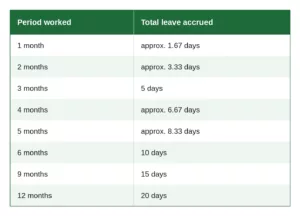
The table shows how vacation entitlement accrues for each full month of work. This does not mean that every person who begins employment during the year will acquire the right to 12 months of vacation in that same year.
In practice, vacation is calculated in hours. With a standard eight-hour workday, one day of vacation equals eight hours. However, this does not mean that after each month, an employee can automatically take two full days off. What matters is the actual amount of accrued vacation time and the rules governing its granting. As a general rule, vacation is granted for an entire scheduled workday, and taking only part of a day is permitted only in situations specified by law.
If an employee has already been employed long enough to be entitled to 26 days of vacation per year, after each completed month of initial employment, they acquire the right to 1/12 of 26 days, or 2 and 1/6 of a day.
03
When can you take your first vacation? Specific examples
The most important rule is simple: the right to the first vacation entitlement arises after one full month of work. However, this does not have to be a calendar month beginning on the first day of the month. If employment begins in the middle of the month, the date on which the right to the first portion of vacation is acquired is calculated from the date employment begins.
Example 1. First Job Starting March 1
An employee begins their first full-time job on March 1, 2026. As of March 31, they become entitled to 1/12 of their annual leave, or 1 and 2/3 days. After three months of employment, as of the end of May, they will be entitled to five days of vacation, provided they have not used it earlier. If they continue their employment, subsequent portions of vacation will be accrued at the end of each following month.
Example 2. Hiring Mid-Month
An employee starts their first job on June 15, 2026. The first month of employment ends on July 14, at which point the employee becomes entitled to the first portion of their vacation. Therefore, there is no need to wait until the end of July. The next portion of vacation will be accrued at the end of the following month of employment, i.e., August 14.
Example 3. First Job at the End of the Year
An employee begins their first job on November 1, 2026, and has a permanent contract. At the end of November, they become entitled to 1/12 of their annual leave entitlement, and at the end of December, to the next portion. In total, this will amount to 3 and 1/3 days of vacation for 2026, assuming an annual entitlement of 20 days.
If the employment continues, starting January 1, 2027, the employee will be entitled to additional vacation under the general rules. They do not need to first complete a full 12 months of work from the start of their first job.
04
20 or 26 days of vacation? Length of service matters
The standard amount of annual leave in Poland is 20 or 26 days per year for a full-time employee. The length of service determines which limit applies to a given employee. With less than 10 years of service, an employee is entitled to 20 days of vacation; however, after reaching at least 10 years of service, the annual entitlement increases to 26 days.
This does not mean, however, that only periods worked under an employment contract count toward vacation service. The Labor Code also allows for certain periods of education to be included. For example, completing a college degree counts as eight years toward vacation eligibility, regardless of whether it was a bachelor’s, engineering, or master’s degree. However, periods of study at subsequent schools are not added together, and periods of study and employment occurring simultaneously are accounted for according to the rules set forth in the regulations.
For example, a college graduate who starts their first job under an employment contract already has eight years of vacation eligibility. As a general rule, it is only after an additional two years of qualifying service that they will reach the threshold entitling them to 26 days of vacation per year. This does not mean, however, that they are not entitled to vacation time during the first two years. In the first calendar year, vacation time accrues gradually, while in subsequent years it is granted in accordance with general rules.
It is also worth remembering that part-time employees have their vacation time calculated in proportion to their working hours. For example, a part-time employee whose full-time annual vacation entitlement would be 20 days is, as a general rule, entitled to 10 days of vacation per year.
05
Changes to Length of Service in 2026. Who Can Get More Vacation Time?
Expanded rules for calculating length of service have been in effect since 2026. In the public sector, they took effect on January 1, and for employers outside the public finance sector, on May 1. The new regulations allow for the inclusion of specific periods of professional activity that were not previously counted toward length of service under the same rules.
The changes apply, among other things, to periods during which individuals performed contract work or operated a business. To have these periods counted, statutory requirements must be met, and the relevant period must be properly documented—most often by means of a certificate from the Social Insurance Institution (ZUS). The new regulations also cover specific periods of professional activity that occurred before the provisions took effect.
This is also important for individuals who are just starting their first job under an employment contract. If they previously ran a business or performed contract work for many years, their vacation entitlement may be higher than would be indicated by their full-time employment history alone.
In practice, a person starting their first job under an employment contract may therefore already have the required length of service entitling them to 26 days of annual leave. However, during the calendar year of their first employment, they will continue to accrue leave gradually, at a rate of 1/12 of the total entitlement for each completed month of work.
It is also important to properly document previous periods of professional activity. The regulations provide certain employees with a 24-month deadline to submit documents confirming periods eligible for inclusion under the new rules. Therefore, individuals who previously worked under civil law contracts or operated a business should verify which documents are required to recalculate their length of service.
06
Your First Job and Changing Employers: Don't Confuse These Rules
One of the most common misunderstandings is treating the first year with a new employer the same as one’s very first job. However, the Labor Code clearly distinguishes between these situations.
If you are entering into an employment contract for the first time, you accrue vacation time in the calendar year you start work after each completed month. This rule also applies if you change employers within the same year. Simply moving to another company does not automatically mean that the rules for accruing vacation time change.
However, if you were already employed under an employment contract in the previous calendar year and are now changing companies, you do not restart the vacation accrual at the rate of 1/12 per month. In this case, the rules governing subsequent vacation accrual apply, including the proportional calculation of vacation entitlement across different employers.
Suppose an employee entitled to 20 days of annual leave begins employment with a new employer on July 1, 2026, and will work until the end of December. Their annual leave entitlement with this employer for that period will generally amount to 10 days, taking into account any leave taken earlier in the same year and other statutory calculation rules.
This is precisely why, when changing jobs, it is important to provide an employment certificate from the previous employer. This document helps determine, among other things, the length of previous employment and the number of vacation days taken in a given year.
07
Can I take vacation time before completing my first month of work?
An employee starting their first job does not automatically acquire the right to annual leave on the first day of employment. If the first month of employment has not yet elapsed, there is no statutory entitlement to annual leave under the terms set forth in Article 153 of the Labor Code. Therefore, the employee cannot assume that they will be able to take part of their annual leave during the first week of employment.
However, this does not mean that in every situation they must remain at work the entire time without the possibility of taking time off. They may take advantage of other legally provided options if they meet the conditions for their application. Under certain circumstances, it is also possible to arrange for unpaid leave with the employer. However, it is important to remember that unpaid leave does not entitle the employee to wages and, as a general rule, is not counted toward the period of employment on which employee entitlements depend.
After accruing the first portion of their vacation time, an employee may submit a request to take it. However, simply becoming entitled to days off does not mean that an employee can unilaterally choose the dates and simply not show up for work. Vacation time must be granted by the employer in accordance with applicable regulations and work organization.
08
Is unused vacation time from the first year forfeited?
Unused vacation time does not automatically expire at the end of the calendar year. If an employee has earned the right to a certain amount of vacation time but has not had the opportunity to use it, it generally carries over to the following year as accrued vacation.
For example, a person who starts work on November 1 may accrue 3 and 1/3 days of vacation by the end of December, assuming an annual entitlement of 20 days, and may not use it before the New Year. In this case, they retain the right to the unused portion, and starting in January—if they are still employed—they also become entitled to vacation for the next calendar year.
In principle, accrued vacation time should be granted no later than September 30 of the following calendar year. Exceeding this deadline does not automatically result in the loss of the right to vacation, although the employer is required to comply with the statutory rules governing its granting.
The situation is different when employment ends. If an employee has not used their accrued vacation time and it is not settled by granting time off in accordance with the regulations, they are generally entitled to a cash equivalent.
It is therefore a good idea to check your vacation balance regularly and plan your time off well in advance. The first year of employment often involves an intensive onboarding process, but that does not mean you should completely forgo rest.
09
Your First Year on the Job and Vacation Time: What Should You Keep in Mind?
During the first calendar year of employment, vacation leave is accrued gradually at the end of each month of employment. For an annual entitlement of 20 days, this amounts to 1 and 2/3 days per month, and for an entitlement of 26 days, it amounts to 2 and 1/6 days. In the following calendar year, the employee becomes entitled to vacation leave under general rules, and the amount of leave depends on the employee’s length of service and the employee’s full-time equivalent.
The changes taking effect in 2026 are also particularly significant, as they allow for additional periods of professional activity to be taken into account when determining length of service. Therefore, before planning your first vacation, it’s worth checking not only your start date but also all periods that may affect your entitlement.
Your first job does not mean you are not entitled to time off. It simply means that in your first calendar year, you accrue vacation time under different rules than employees taking their subsequent vacation.

