





TABLE OF CONTENTS
- What is the notice period for an employment contract?
- What is the notice period for an employment contract in 2026?
- How to Calculate the Notice Period? Examples
- What counts toward length of service when calculating the notice period?
- Can the notice period be shortened?
- Do you have to work during the notice period?
- Time off to look for a job during the notice period
- How do you properly give notice of termination of an employment contract?
- Notice Period and Changing Jobs—What Should You Keep in Mind?
- What should you keep in mind about the notice period?
Changing jobs, receiving a new job offer, or deciding to end your employment with your current employer requires you to complete certain formalities. One of the most important is determining the notice period for the employment contract. Its length depends primarily on the type of contract and the length of service with the employer. What is the notice period in 2026, how do you calculate it correctly, and is it possible to terminate employment earlier?
01
What is the notice period for an employment contract?
The notice period is the time between the effective submission of a notice of termination and the date of termination of employment. During this time, the employee generally continues to perform their duties, and the employer pays the employee’s wages in accordance with the terms of employment. This arrangement allows both parties to prepare for the end of the employment relationship. The employee can wrap up their professional affairs and plan their next career steps, while the employer gains time to transfer responsibilities or find a replacement.
The rules governing the termination of contracts are set forth in the Labor Code, primarily in Articles 30, 34, and 36. Importantly, either the employee or the employer may give notice of termination. For both fixed-term and indefinite-term contracts, the statutory notice period is generally the same regardless of which party decides to terminate the employment. However, this does not mean that every contract terminates after the exact same amount of time. The type of contract, the duration of employment, and any specific provisions are all relevant factors.
02
What is the notice period for an employment contract in 2026?
The length of the notice period depends primarily on the length of service with a given employer. The law provides for three basic periods: two weeks, one month, and three months. These rules apply to both fixed-term and indefinite-term contracts. Separate, shorter periods apply to probationary contracts—we describe them in the next section.
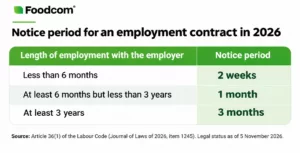
For example, an employee who has been with a company for four months will generally be subject to a two-week notice period. If the employee has been with that employer for one year, the notice period will be one month, and after reaching three years of service, it will be extended to three months.
It is important to remember that when determining the length of the notice period, the length of service—which also includes the duration of the notice period itself—is a key factor. If an employee reaches the six-month or three-year employment milestone during this time, a longer notice period may apply. Therefore, before submitting any documents, you should check not only the start date of employment but also the date on which the next service milestone is reached.
03
How to Calculate the Notice Period? Examples
One of the most common mistakes is assuming that a one-month notice period ends exactly one month after the date the notice is submitted. In reality, the method for calculating these periods is specified in the Labor Code and depends on whether the notice period is expressed in weeks or months.
For weekly notice periods, the contract is always terminated on a Saturday. Monthly notice periods, on the other hand, end on the last day of the month, regardless of whether it falls on a business day, a weekend, or a holiday.
Example 1. Two-week notice period
An employee who has been employed for three months submits a notice of termination in the middle of the week, for example, on Tuesday. The two-week notice period does not begin immediately but starts on the following Sunday and covers two full weeks, counted from Sunday through Saturday. The contract will therefore terminate on the Saturday marking the end of the second of those weeks.
In practice, more than two weeks usually pass between the submission of the notice and the end of employment. Exactly two weeks will elapse only if the notice is submitted on a Saturday.
Example 2. One-month notice period
An employee with two years of service submits a notice of termination in November. The one-month notice period will begin at the start of December and will cover the entire month; therefore, the contract will terminate on the last day of December. It does not matter whether the notice reaches the employer at the beginning or end of November—the contract termination date will remain the same.
Example 3. Three-month notice period
An employee who has been with the company for five years submits a notice of termination in November. The three-month notice period will begin at the start of December and will cover three full calendar months: December, January, and February. The contract will terminate on the last day of February.
These examples illustrate how important the timing of submitting a notice of termination is. For monthly notice periods, the decisive factor is the month in which the notice reaches the other party: a document submitted on the last day of the month terminates the contract a full month earlier than one submitted a day later. Therefore, when planning to start work at a new company, it is advisable to determine the exact termination date of your current contract well in advance.
04
What counts toward length of service when calculating the notice period?
When determining the length of the notice period, it is not only the time worked under the current contract that is taken into account. As a general rule, the total period of employment with a given employer is considered, even if the employee was previously employed by the same company and there were gaps between successive contracts.
For example, a person who worked at a company for two years, then changed employers, and after some time returned to the previous company and worked there for another year, may have a total of three years of service entitling them to a three-month notice period. The regulations also provide for the inclusion of specific periods of employment with a previous employer, including in cases where a workplace is transferred to a new employer.
An important change was introduced in 2026. Effective January 1 in the public sector and May 1 in the private sector, regulations came into force that expand the rules for determining length of service. These regulations allow, upon meeting statutory conditions and providing appropriate documentation, for the inclusion of, among other things, specific periods of performing a contract of mandate and conducting business activity.
However, when it comes to the notice period, the key point is that it is the length of service with a given employer that counts, not the total history of professional activity. For example, a previous contract of mandate performed for the same employer may now affect the length of the notice period. This is a significant change for individuals who worked with a company on a different basis before entering into an employment contract.
The new rules do not apply to notices of termination that were already in progress. If the notice period was ongoing on the date the regulations took effect (January 1, 2026, in the public sector; May 1, 2026, in the private sector), its length is determined according to the previous rules.
It is also important to keep in mind the deadline for submitting documents. An employee who is employed on the effective date of the regulations has 24 months from that date to provide the employer with evidence confirming additional periods of employment—most commonly, certificates from the Social Insurance Institution (ZUS). Periods not documented within this timeframe will not be counted toward the employee’s length of service.
05
Can the notice period be shortened?
A three-month notice period does not always align with an employee’s career plans. A new employer may expect the employee to start work sooner, and the employee leaving the company may wish to wrap up their current responsibilities more quickly. The Labor Code provides for the possibility of setting an earlier termination date, but this requires meeting certain conditions.
The simplest solution is an agreement between the employee and the employer. After the notice of termination is given, the parties may jointly set an earlier date for the termination of employment. For example, an employee subject to a three-month notice period may agree with the employer to terminate the contract after one month. Such an agreement does not change the manner of termination; the contract still ends upon notice.
There are also situations in which an employer may unilaterally shorten the three-month notice period to a maximum of one month. This applies, among other things, to bankruptcy, the employer’s liquidation, and specific reasons unrelated to the employees. In such a case, the employee is entitled to compensation for the remaining portion of the notice period.
It is important to distinguish between shortening the notice period and terminating the contract by mutual agreement. In the latter case, the parties jointly determine the date of termination without having to observe the statutory notice period. However, neither party may unilaterally impose such a termination.
06
Do you have to work during the notice period?
Simply submitting a notice of termination does not automatically relieve an employee of their duties. Until the contract is terminated, the employee generally remains employed under the existing terms. The employee retains the right to compensation but must also carry out assigned tasks, comply with work organization rules, and follow lawful instructions from supervisors.
However, the employer may decide to release the employee from the obligation to work until the end of the notice period. In such a situation, the employee is not required to perform daily tasks but still retains the right to wages. This solution is sometimes applied, among other things, when the handover of duties has already been completed or the employee’s continued presence is no longer necessary.
It is also possible to take annual leave during the notice period. If the employer grants the employee’s accrued annual leave during this time, the employee is required to take it (Article 167¹ of the Labor Code). If, upon termination of employment, there is unused vacation time for which the employee is entitled to compensation, the employer is generally required to pay a cash equivalent.
07
Time off to look for a job during the notice period
Not every employee is aware that, in certain situations, the Labor Code provides for additional days off to search for new employment. However, this right applies only when the employer gives notice of termination and the notice period is at least two weeks.
Three business days are also granted if the three-month notice period has been shortened by the employer pursuant to Article 36¹ of the Labor Code.
During this leave, the employee retains the right to pay. These days may be used, among other things, for job interviews and meetings with potential employers. However, they are not automatically granted to every person leaving the company. If the employee has given notice, the statutory right to time off to look for work does not apply.
08
How do you properly give notice of termination of an employment contract?
Notice of termination of an employment contract must be submitted in writing, that is, with a handwritten signature. An electronic form is equivalent, but only if it includes a qualified electronic signature. A regular email, a scanned document, or a message sent via an instant messaging app does not meet this requirement.
The document should clearly identify the parties, include a statement terminating the contract, and bear the date and signature of the person giving notice. It is also advisable to specify the type of contract and the date it was entered into. From the employee’s perspective, it is particularly important to obtain confirmation of delivery of the document, as the effective date of termination depends on when the notice is successfully submitted.
As a general rule, an employee is not required to state the reason for their decision. The situation is different for an employer terminating a fixed-term or indefinite-term contract. In such a case, the employer must specify the reason justifying the termination and include a notice regarding the right to appeal to a labor court.
It is also worth remembering that a notice of termination is a unilateral declaration of intent. This means that, as a general rule, its effectiveness does not require the consent of the other party. Therefore, the employer does not have to “accept” a properly served notice of termination submitted by the employee for it to take legal effect.
09
Notice Period and Changing Jobs—What Should You Keep in Mind?
Planning a job change requires taking into account not only the end date of your current contract but also the responsibilities involved in handing over your position. Before accepting a new offer, it’s a good idea to confirm when you’ll actually be able to start the new job. This is particularly important for employees with longer tenure, who are subject to a three-month notice period.
A sensible approach is to review the terms of your contract in advance, carefully calculate the notice period, and discuss the terms of your departure with your current employer. Professionally handing over your responsibilities, organizing your documentation, and informing your colleagues about key matters will help you avoid unnecessary organizational issues.
Terminating employment is a natural stage of professional development. A well-managed departure process helps maintain positive relationships that may prove valuable in the future as well.
10
What should you keep in mind about the notice period?
The notice period for terminating an employment contract depends primarily on the type of contract and the length of service with the employer. For fixed-term and indefinite-term contracts, it is most often two weeks, one month, or three months. Different rules apply to employment during a probationary period, and the method for calculating the contract’s termination date depends on whether the period is specified in business days, weeks, or months.
Before deciding to change jobs, it’s a good idea to check your rights, take into account the new rules for calculating length of service that will take effect in 2026, and carefully plan the termination date. Understanding the regulations helps you avoid misunderstandings and smoothly transition to the next stage of your career.

